Skip to content

In solvent procurement, few chemicals occupy as many distinct roles as n-heptane. It is the international zero point of the octane rating scale, a trusted extraction medium for pharmaceutical and botanical processing, and a workhorse aliphatic solvent for coatings, adhesives, and laboratory analysis. For buyers specifying heptane at industrial volumes, understanding its properties, grades, and logistics is essential to sourcing the right material at the right specification. This guide from Dongying Eastchem Co., Ltd, a Dongying, Shandong-based chemical exporter with nearly two decades of manufacturing experience, covers what heptane is, how it is used across industries, and how to choose the grade that matches your process.
What Is N-Heptane? Chemical Profile and Key Properties
N-Heptane (normal heptane, CAS 142-82-5) is a straight-chain saturated alkane with the molecular formula C7H16 and a molecular weight of 100.21. It sits in the middle of the light aliphatic hydrocarbon family, between n-hexane and n-octane, and shares their defining characteristics: it is a colorless, transparent liquid with a mild, characteristic hydrocarbon odor, it evaporates cleanly with virtually no residue, and it is practically insoluble in water while mixing freely with most organic solvents.
Physical properties buyers should verify on every specification sheet
- CAS number: 142-82-5; formula C7H16; molecular weight 100.21
- Boiling point: 98.4 °C, with a typical commercial distillation range of 97.0–99.5 °C
- Density: approximately 0.684 g/cm³ at 20 °C
- Appearance: colorless transparent liquid with a characteristic hydrocarbon odor
- Solubility: practically insoluble in water; miscible with ethers, alcohols, and hydrocarbons
- Volatility: fast evaporation rate; classified as a volatile organic compound (VOC)
For most applications, the two numbers that matter most are purity and distillation range. A narrow boiling spread confirms the material is genuinely normal heptane rather than a blended hydrocarbon fraction, and it guarantees consistent evaporation behavior from drum to drum — the kind of reproducibility that reference-fuel work and regulated extraction both depend on.
N-Heptane as the Zero-Point Octane Reference Fuel
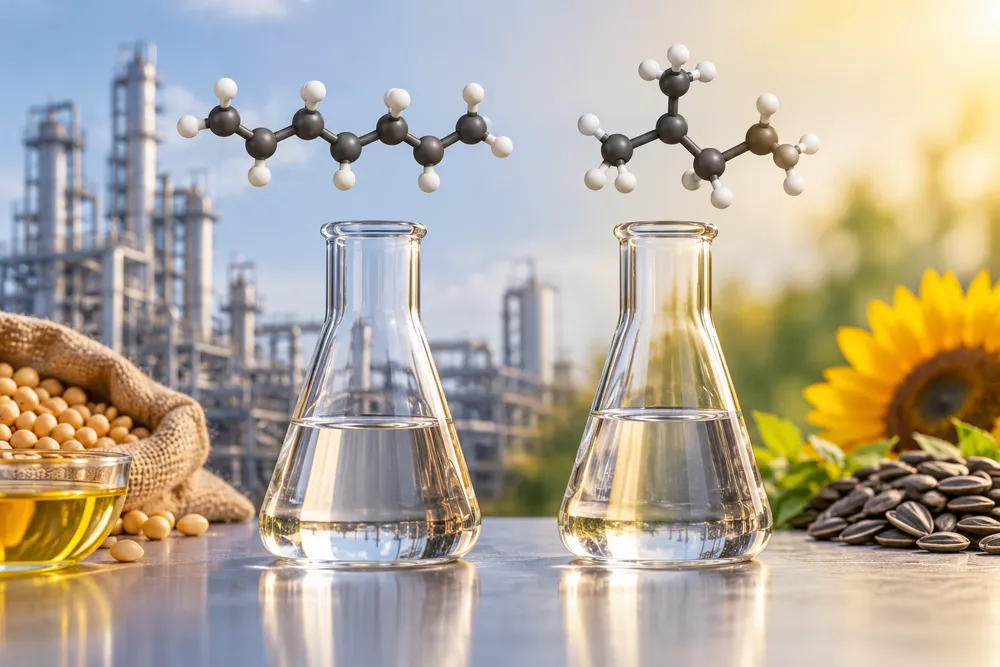
Of all the roles this molecule plays, the most famous is definitional. By international convention, n-heptane is assigned an octane rating of exactly zero, while isooctane (2,2,4-trimethylpentane) is assigned 100. Its straight-chain structure burns with severe knock in a gasoline engine, which is precisely what makes it useful: it anchors the bottom of the scale against which every motor fuel is measured.
How octane numbers are measured in CFR engines
Octane ratings are determined in a standardized single-cylinder Cooperative Fuel Research (CFR) engine under methods such as ASTM D2700, the motor method that yields the motor octane number (MON), alongside the research method used for RON. The operator runs the sample fuel, then brackets its knock intensity against primary reference fuels — binary blends of n-heptane and isooctane. A blend of 90 percent isooctane and 10 percent heptane defines octane number 90. Because the entire measurement chain traces back to these two pure hydrocarbons, any laboratory or fuel-testing facility needs reference material of very high, verifiable purity.
The isooctane pairing: two sides of one scale
Reference-fuel buyers almost always procure the pair together. Dongying Eastchem supplies isooctane as the RON 100 endpoint alongside high-purity n-heptane at 99%+ with a certificate of analysis for every batch, giving testing laboratories a matched reference-fuel set with consistent, documented quality from a single source.
Heptane for Extraction: Pharmaceuticals and Botanical Oils
Beyond the test engine, the largest and fastest-growing use of high-purity heptane solvent is extraction. Like other light paraffins, heptane dissolves nonpolar compounds — vegetable and botanical oils, resins, waxes, and lipophilic actives — while leaving polar impurities, chlorophyll-related contaminants, and water-soluble components behind. That selectivity, combined with complete evaporation and low residue, makes heptane for extraction a natural fit for herbal and botanical oil processing, cannabis and hemp extraction, and the purification of pharmaceutical intermediates and fine chemicals.
Why extraction processors choose heptane
Processors select heptane when they want hexane-class solvency with different handling characteristics. Its higher boiling point of 98.4 °C reduces evaporative loss in warm climates and warm process lines, and its clean, narrow distillation range makes solvent recovery by distillation straightforward. For finished products destined for human or animal consumption, a pharmaceutical or extraction grade of at least 99 percent purity — with tightly controlled water and sulfur content — keeps nonvolatile impurities out of the final extract. And because the solvent is stripped from the concentrate by evaporation and distillation before finishing, its volatility and residue profile directly shape the color, taste, and compliance of the end product, which is why experienced processors treat solvent selection as a product-quality decision rather than a purchasing afterthought.
N-Heptane versus n-hexane: a safety-informed substitution
The most common comparison in extraction planning is against n-hexane. Hexane is well documented to cause peripheral neuropathy through its metabolite 2,5-hexanedione, which is why occupational exposure limits and food-grade regulations scrutinize it so closely. Heptane’s metabolic pathway does not produce this specific axon-toxic metabolite, so many botanical and pharmaceutical processors have moved to heptane as a lower-toxicity alternative, accepting a somewhat higher boiling point and slightly lower solvency power in exchange for a stronger occupational-safety profile. For applications where worker exposure is hard to eliminate entirely, that trade often justifies the switch.
Industrial and Laboratory Applications of Heptane Solvent
The commercial versatility of this molecule extends far beyond fuel testing and extraction plants. Across the chemical, materials, and analytical industries, heptane solvent is valued precisely because it is chemically unreactive, evaporates completely, and dissolves a broad range of nonpolar substances.
Laboratory and analytical uses
- Chromatography and reference standards: gas chromatography reference material and a nonpolar eluent in adsorption chromatography
- Reaction medium: inert, nonprotic solvent for organic synthesis, catalysis, and polymerization studies
- Recrystallization and washing: growing and rinsing crystals of nonpolar organic solids
- Extraction and partitioning: liquid–liquid extraction of nonpolar analytes in analytical methods
- Cleaning: residue-free degreasing of glassware, precision parts, and sensitive electronic components
Industrial uses
- Adhesives and rubber cement: low-residue solvent for pressure-sensitive and contact adhesives
- Paints and coatings: fast-evaporating diluent and thinner for alkyd, rubber-based, and bituminous coatings
- Grinding and flotation: wetting and flotation agent in mineral and ore processing
- Silicones and sealants: viscosity reducer and carrier for silicone and polymer preparations
- Organic synthesis: process solvent and crystallization medium for fine chemicals
Where a slower evaporation profile or higher solvency for heavier resins is needed, buyers frequently pair heptane with n-octane, its C8 neighbour in the alkane series, to fine-tune drying time in coating and adhesive formulations.
How to Choose the Right N-Heptane Grade
Because the same CAS number covers materials sold at very different quality levels, specifying the correct grade is where most sourcing value is won or lost. Over-specifying wastes money; under-specifying risks contamination, failed audits, and out-of-spec finished products. A useful rule of thumb: the closer the solvent comes to the end consumer, the tighter the specification must be. The choice comes down to how the solvent will be used and what ends up in the final product.
Industrial grade
For paints, coatings, adhesives, rubber processing, and mineral flotation, standard industrial-grade heptane is usually sufficient. The specification should emphasize a dependable distillation range and consistent density rather than absolute purity, which keeps cost per kilogram competitive for high-volume consumption.
Pharmaceutical and extraction grade
For botanical oil extraction, pharmaceutical intermediates, and any process with human exposure or regulated end products, specify pharmaceutical-grade n-heptane at 99%+ purity, with water content below 0.005 percent, sulfur limited to parts-per-million levels, and a batch-specific certificate of analysis covering the full distillation range. These controls guarantee that what evaporates away leaves nothing behind in the extract.
Laboratory grade
For chromatography, reference-fuel blending, and analytical work, purity and lot-to-lot consistency are everything. Demand a COA for each lot, including actual measured purity, and confirm the supplier can document the same narrow distillation range on repeat orders so methods remain comparable over time.
Before committing to any volume, a disciplined buyer should ask the supplier five questions: What is the guaranteed minimum purity? What does the batch COA actually show? How tight is the distillation range? What packaging and palletization options are available? And can pre-shipment samples be provided for in-house qualification? A supplier who answers all five quickly is usually a supplier who can ship reliably.
Safety, Handling, and Transport of Heptane
Heptane is a highly flammable liquid with a flash point of approximately −4 °C, and it is regulated as a volatile organic compound in many jurisdictions. Storage areas must be cool, ventilated, and free of ignition sources; transfers should be grounded and bonded to prevent static discharge; and process equipment in contact with heptane vapors should be explosion-proof. Standard personal protection includes chemical-resistant gloves, safety eyewear, and adequate general or local exhaust ventilation, and open handling should be minimized in favor of closed-loop transfer wherever the process allows. For international shipment it is classified as UN 1206, Class 3 flammable liquid, so exporters must be experienced in dangerous-goods documentation, packaging certification, and carrier requirements — an area where an established Chinese producer with regular DG export experience adds real value.
Packaging should be matched to consumption volume: 200-liter steel or galvanized drums of roughly 137 kg net suit multi-drum orders and smaller users, while ISO tanks and tank trucks serve bulk consumers running continuous extraction or formulation lines. Drummed cargo ships in standard containers; ISO-tank movements offer lower unit logistics cost but require dedicated tank infrastructure at the receiving site.
Conclusion: Work with an Established N-Heptane Supplier
Heptane earns its place in procurement plans through sheer range: it defines the octane scale, extracts botanical and pharmaceutical actives cleanly, and performs as a dependable industrial solvent across adhesives, coatings, and laboratory work. Success in each of these roles depends on the same fundamentals — verified purity, a narrow and repeatable distillation range, correct dangerous-goods handling, and packaging that fits your volume. Dongying Eastchem Co., Ltd delivers all four, with in-house manufacturing, per-batch certificates of analysis, and export experience across drums, ISO tanks, and tank trucks. Visit the N-Heptane product page for full specifications, or contact our sales team through the website to request a COA, discuss grade selection, and obtain a quotation for your next order.