Skip to content
What Is 1-Propanol?
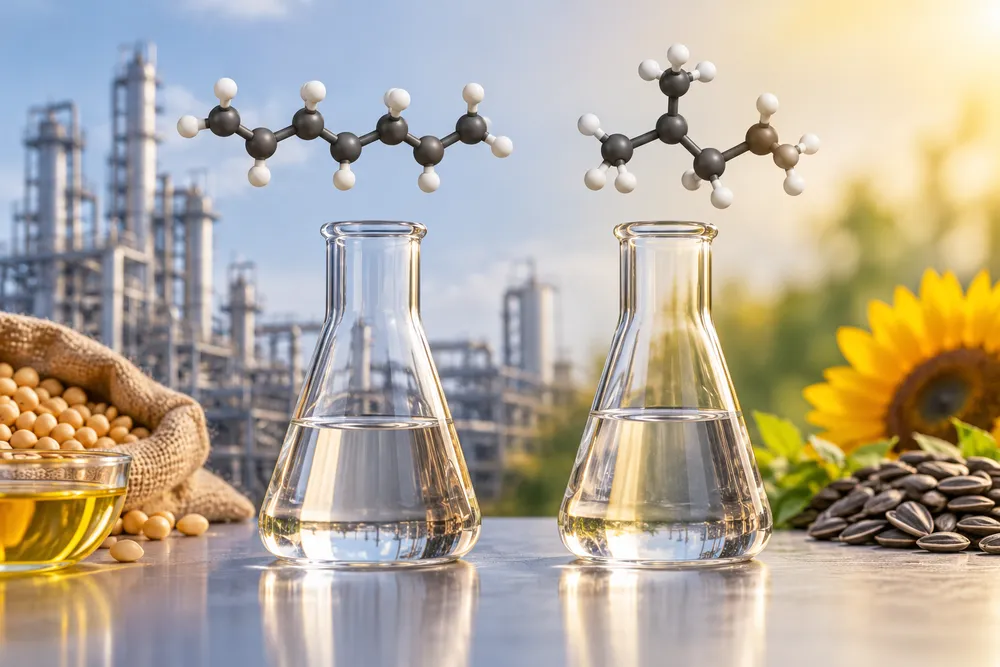
1-Propanol (n-propanol, propan-1-ol; CAS 71-23-8; UN 1274, Class 3 flammable liquid) is a colorless, transparent, mobile liquid with a mild characteristic alcohol odor. It boils at 97.2 ℃, melts at −126 ℃, and has a density of 0.803 kg/L at 20 ℃. Completely miscible with water, ethanol, ether and most organic solvents, it belongs to the small family of C1–C4 alcohols that anchor the global solvent trade. It is the linear isomer of isopropanol; the two molecules share a formula but occupy clearly different positions in formulation practice, and many purchasing teams buy both side by side.
How 1-Propanol Is Produced
Industrial 1-propanol is made mainly by hydroformylation of ethylene: ethylene reacts with synthesis gas (CO + H2) over a rhodium or cobalt catalyst to propanal, which is then hydrogenated to 1-propanol. A secondary stream comes from methanol synthesis and Fischer-Tropsch co-products. Modern plants refine through multi-column distillation to reach 99.5%+ assay with low water, aldehyde and acid values — the impurity triad that matters most to ink and pharmaceutical buyers, because aldehydes cause color drift and odor in finished formulations.
Physical and Chemical Properties
- Density 0.803 kg/L at 20 ℃; dynamic viscosity 1.9 mPa·s — thinner than water, pumps easily at any plant temperature.
- Boiling point 97.2 ℃ — evaporation between ethanol (78 ℃) and 1-hexanol (157 ℃), the basis of its use as a tail solvent.
- Flash point approximately 15 ℃ (closed cup) and autoignition near 371 ℃: standard Class 3 flammable handling.
- Primary alcohol chemistry: esterifies to propyl acetate and propyl butyrate, oxidizes to propanal and propionic acid, undergoes amination to propylamines.
- Odor threshold moderate; residual odor milder than isopropanol at equal purity, relevant to fragrance-sensitive products.
Applications in Depth
Printing Inks
The classic use. Flexographic and rotogravure inks for flexible packaging, paper and labels need an alcohol that dissolves nitrocellulose and polyamide binders while evaporating in step with press speeds. 1-Propanol’s evaporation rate (slower than ethanol, faster than n-butanol) keeps ink open-time stable on long runs, and its strong solvency maintains viscosity control in recycled solvent loops. Ink makers frequently blend it with ethanol and n-propyl acetate to build an evaporation ladder across the print units.
Coatings and Adhesives
In nitrocellulose lacquers, acrylics and alkyd systems, 1-propanol serves as an active solvent and viscosity cutter. In adhesives it wets substrates and adjusts open time. Its water miscibility makes it the coupling solvent of choice in water-reducible systems, where it stabilizes the resin-water blend through the dilution window.
Pharmaceutical and Agrochemical Intermediates
The propanol molecule is a propyl-group donor in active-ingredient synthesis — propyl esters for pharmaceuticals, propanol-based propylamines for agrochemicals, and propyl carbonate-type derivatives. Its primary-hydroxyl reactivity and clean impurity profile suit GMP-adjacent intermediate work, where buyers specify low aldehydes and controlled water.
Cosmetics, Flavors and Feed
1-Propanol is a processing solvent for fragrances and a building block for flavor esters such as propyl acetate and propyl butyrate — the fruity notes of many food flavors. In feed-additive chemistry it appears in vitamin and additive esterification steps.
Cleaning and Electronics
As a fast-drying, residue-free alcohol it cleans glass, metal and optical parts; electronics users typically choose isopropanol for cost, but 1-propanol appears where its slower evaporation gives better wetting on intricate parts.
1-Propanol vs Isopropanol vs Ethanol
Purchasers often ask which alcohol belongs in which tank. Ethanol evaporates fastest and is the disinfectant standard but carries excise and denaturing complexity. Isopropanol, the branched secondary alcohol, evaporates fast with excellent degreasing power and dominates electronics cleaning at attractive cost. 1-Propanol evaporates more slowly, wets longer, dissolves a partially different resin set, and carries a cleaner residual odor. In ink plants the three often coexist deliberately: ethanol for early print units, 1-propanol for mid-deck, propyl acetate tail. Consolidated sourcing of the family from one supplier simplifies what is otherwise three separate quality systems.
Handling, Storage and Safety
Store in tightly closed steel drums or tanks in cool, well-ventilated areas away from ignition sources; bond and ground during transfer; use explosion-proof equipment in filling areas. Personal protection: chemical goggles and nitrile gloves; the product irritates eyes and skin, and vapor concentrations above exposure limits require respiratory protection. Consult the SDS — a full dangerous-goods document set accompanies every EastChem shipment of UN 1274 product.
Grades and Specifications
Standard industrial grade: 99.5% minimum assay by GC, water below 0.1%, acidity below 0.005%, aldehydes low-single-digit ppm, color 5 Pt-Co maximum. Pharmaceutical-intermediate grade tightens aldehydes and peroxide limits. Packaging: 160 kg steel or blue plastic drums; IBC totes and ISO tanks on request. Every lot ships with COA; shelf life 24 months sealed.
Global Market and Trade Patterns
1-Propanol is a mid-volume solvent — world demand measured in hundreds of thousands of tons rather than the millions of its cousins ethanol and isopropanol — and that scale shapes how buyers should contract it. Production sits with C1–C4 chemical complexes in East Asia, with product flowing to ink, pharma and coating users worldwide in drums, IBC and ISO tanks. Because capacity is concentrated, single-plant outages move regional availability; buyers running continuous ink or intermediate production typically qualify two suppliers and keep a standing volume plus spot formula, with samples approved in advance so switching is administrative rather than technical. Price tracks ethylene and syngas economics with a lag, and historically trades at a premium to isopropanol — a premium justified wherever its slower evaporation, different solvency or cleaner odor is genuinely required.
Documentation and Compliance Checklist
For international shipments the routine document set includes: COA with GC assay, water, acidity and aldehyde figures; MSDS in the destination language; UN 1274 dangerous-goods declaration with packing class; certificate of origin; and for pharma-chain buyers, an impurity statement covering peroxides and residual aldehydes. Importers in some markets add REACH or equivalent registration confirmation for the substance identity. None of this is exotic — but assembling it in one working day is exactly what separates a supplier who ships containers from a supplier who solves problems. EastChem maintains the complete set as standard, refreshed per lot.
Practical Plant Engineering Notes
Facilities metering flammable alcohols do well with a few consistent practices: dedicated positive-displacement or mass-flow metering (viscosity changes with temperature are small but real), nitrogen-blanketed day tanks to keep water pickup near zero, and closed-loop transfer with vapor return where local VOC rules apply. Fire discipline around a 15 ℃ flash-point liquid is standard hazardous- area engineering — zoning, grounding, explosion-proof fixtures — and the same discipline that already governs ethanol or IPA storage transfers directly. Because 1-propanol is fully water-miscible, spill response is simple containment and dilution, but the environmental permit side of a solvent spill should still be pre-arranged with your EHS contractor.
Ordering Summary
For purchasing teams consolidating the short-chain alcohol family, the working pattern is simple: qualify 1-propanol alongside isopropanol with the same document set, order both on one purchase order when tank and drum logistics allow, and hold a standing quarterly volume with spot top-ups for ink-season peaks. EastChem quotes the family together — 1-propanol, isopropanol, 1-hexanol and the glycols — so one quality audit and one customs entry cover the full solvent palette of an ink, coating or fragrance operation.
Why Source 1-Propanol from Dongying EastChem
We are a 19-year chemical manufacturer with three subsidiaries and deep fresh stock of 1-propanol at 99.5% assay. Quality is the foundation of a supplier; what decides long-term reliability is everything around the molecule — documentation discipline, on-time containers, and technical answers within the working day. Consolidation is our specialty: 1-propanol ships together with isopropanol, 1-hexanol, glycols and the wider alcohols range in one container with one document set. Minimum order one 20-foot container, samples dispatched in about 2 days, payment by T/T or L/C.
About this guide: this page is maintained by Dongying EastChem as a working reference for 1-propanol buyers and formulators. Data points reflect typical industrial values and our supply specifications; for binding figures always refer to the COA of the lot delivered. Specifications, sourcing logic and handling guidance are updated as grades and packaging options evolve. Buyers integrating 1-propanol into ink, coating or intermediate programs can request the current documentation pack and consolidation examples from our alcohols category with their quotation.
Frequently Asked Questions
What is the difference between 1-propanol and isopropanol?
They are constitutional isomers. 1-Propanol is a linear primary alcohol; isopropanol is a branched secondary alcohol. 1-Propanol evaporates more slowly, wets surfaces longer and carries a cleaner residual odor; isopropanol is the low-cost standard for cleaning and disinfection.
What purity and impurity limits should I specify?
99.5% minimum assay with water below 0.1% and tight aldehyde limits. For inks and pharma intermediates, aldehyde control prevents color drift and odor; a GC-based COA with every lot is the norm.
How is 1-propanol used in printing inks?
As the mid-evaporation alcohol in flexographic and gravure solvent systems, dissolving nitrocellulose and polyamide binders while stabilizing viscosity and open time on long runs.
Is 1-propanol dangerous to store?
It is a Class 3 flammable liquid (UN 1274, flash point near 15 ℃). Standard flammable-liquids storage — cool, ventilated, away from ignition, grounded transfer — is fully sufficient with the provided SDS.
What packaging options are available?
160 kg steel or blue plastic drums as standard; IBC totes and ISO tanks on request for volume users.
Can you consolidate 1-propanol with other solvents in one container?
Yes — combining 1-propanol with isopropanol, 1-hexanol and glycols in a single shipment with one document set is routine and reduces logistics cost per ton.
Contact for quotations and samples:
Billy Lu
WeChat/Phone: +86 182 5464 4858 · WhatsApp: +86 182 5464 4858
Email: [email protected] · Alibaba: dyeastchem.en.alibaba.com