Skip to content

Few industrial chemicals sit as close to the edge of their own boiling point as isopentane. At 27.8 °C, this colorless, mobile liquid will boil on a warm afternoon, and that single fact shapes how it is made, shipped, stored, and used. For foam producers it is the fast component of the blowing agent; for electronics and metalworking plants it is an exceptionally quick-drying cleaning solvent; for researchers it is both a cryogenic bath medium and a working fluid for waste-heat power cycles. This article explains what 2-methylbutane is, how it performs in EPS and polyurethane foaming, why it is blended with other pentanes, and what matters when buying and storing it.
What Is Isopentane? Chemical Identity and Physical Properties
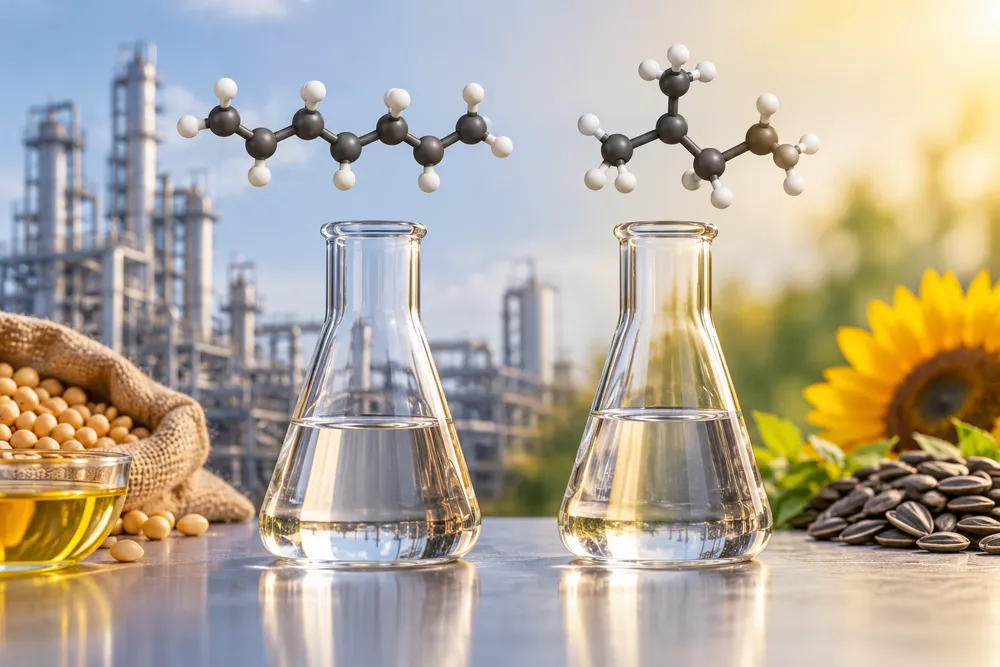
Isopentane, systematically named 2-methylbutane, is the branched-chain isomer of pentane. Its molecular formula is C5H12 — identical to that of n-pentane, but one methyl group sits on the second carbon of a four-carbon chain instead of extending it. The compound is listed under CAS number 78-78-4 and carries a molecular weight of 72.15 g/mol. That modest branch changes the behavior considerably: it lowers the boiling point from 36.1 °C for the straight-chain isomer to 27.8 °C, reduces density, and raises vapor pressure at every working temperature, making the liquid noticeably more eager to evaporate.
The Branch That Sets It Apart from n-Pentane
The single branch point is the reason many processors deliberately choose one isomer over the other. The branched molecule evaporates faster, builds vapor pressure earlier, and diffuses through polymer cells more quickly than its straight-chain cousin. In a factory this translates into faster blowing in foam pre-expanders, shorter drying times on cleaning lines, and easier vaporization in closed heat-transfer loops. The trade-off is discipline on the handling side, because a liquid that boils near room temperature places stricter demands on container pressure and storage climate than a conventional solvent. Buyers weighing the two isomers against each other can review the detailed n-pentane product specifications for a direct comparison of distillation behavior.
Key Physical Data at a Glance
- CAS number 78-78-4; transported as UN 1265, Class 3 flammable liquid
- Molecular formula C5H12 (2-methylbutane); molecular weight 72.15 g/mol
- Appearance: colorless, highly mobile liquid with a faint gasoline-like odor
- Boiling point 27.8 °C — only a few degrees below typical summer ambient conditions
- Density approximately 0.616 g/cm³ at 20 °C; flash point −51 °C
- Practically insoluble in water, miscible with most common organic solvents
The Isopentane Blowing Agent in EPS and Polyurethane Foam
The largest industrial application of this compound is as an isopentane blowing agent — the volatile liquid that transforms resin beads and polymer systems into lightweight closed-cell foam. Its high vapor pressure makes it the fast-acting component in pentane blends: it vaporizes early in the process, nucleates fine cells, and sets the tone for the expansion that follows. Foam formulators treat it less as a standalone chemical and more as a tuning lever.
EPS Bead Impregnation and Pre-Expansion
Expandable polystyrene begins life as resin beads impregnated with a pentane blowing agent during polymerization. When the beads are heated with steam in a pre-expander, the pentane flashes to vapor and inflates each bead many times over. Because the branched isomer vaporizes more readily than the straight-chain one, a measured share of the branched molecule accelerates early expansion and helps converters reach target density with less steam. Many EPS producers work with n/iso blends in which the branched isomer forms the minority, with the ratio adjusted to the bead grade, the ambient season, and how long finished boards must retain gas. Converters sourcing resin and blowing agent together can also review the expandable polystyrene grades alongside their solvent program.
PU Insulation Foam and Cyclopentane Blends
In rigid polyurethane insulation, the blowing agent remains trapped in closed cells for decades, so its gas thermal conductivity directly governs long-term insulation ratings. Cyclopentane offers the lowest gas conductivity among the pentanes and dominates refrigerator and construction panel foam, but it boils at about 49 °C and mixes reluctantly into polyol systems. Adding isopentane improves miscibility and lowers viscosity, helping the reaction mixture flow into fine, uniform cells before it sets. Formulators therefore pair the two deliberately rather than running either neat, and the corresponding cyclopentane supply specifications deserve the same scrutiny as the iso-grade itself.
Pentane Blend Ratios: Tuning Volatility and Cell Structure
Blending is not an afterthought in pentane chemistry; it is the core of the craft. Every processor settles on a ratio that balances blowing speed, cell quality, dimensional stability, and cost — and defends that ratio tightly once it is proven on the line.
Blends for EPS: Speed Against Gas Retention
The classic EPS combination is n-pentane carrying a smaller fraction of the branched isomer. The straight-chain molecule supplies most of the blowing gas at moderate cost, while the branched molecule adds vapor pressure exactly where pre-expansion needs it. Raising the iso share shortens cycle times; lowering it slows the blow and improves gas retention during aging, because the lighter isomer diffuses out of beads sooner. Typical working blends keep the iso-content a minority fraction, held constant from batch to batch. That consistency is one practical argument for sourcing from a producer who manufactures both isomers on the same line — the isopentane supplied by Dongying Eastchem is documented with batch-specific analysis so converters can verify ratio behavior lot after lot.
Blends for PU: Solubility Against Insulation Value
In polyurethane systems the logic inverts: cyclopentane brings the insulation performance, and the branched isomer is added to dissolve cleanly into the polyol and soften the cell structure. Too little iso leaves the blend cloudy and the foam coarse; too much raises gas conductivity and erodes the lambda value the panel is sold on. Shifts of a few percentage points are enough to move density and insulation figures, so PU buyers prize narrow distillation ranges and low water content in every lot. Water is the hidden enemy here — it reacts with isocyanate to release carbon dioxide and quietly distorts the intended blowing chemistry.
Isopentane Solvent Applications Where Evaporation Speed Counts
Outside foaming, the compound has earned a durable niche as a fast-evaporating solvent prized for one property above all: speed. It dissolves oils, greases, waxes, and many polymers effectively, rejects water almost completely, and flashes off a surface in seconds — a combination few cleaning media can match. Typical uses include:
- Cleaning and degreasing of electronic assemblies, connectors, and precision metal parts before coating or bonding
- Water displacement from delicate mechanisms, exploiting its near-total immiscibility with water
- Carrier and volatility agent in aerosol and personal-care formulations
- Component of specialty fuels and lighter fluids, where clean, complete combustion matters
- Laboratory coolant and rinsing reagent in analytical and synthetic chemistry
Electronics and Precision Parts Cleaning
Manufacturers of circuit assemblies, optical components, and finely machined parts use the solvent to lift processing oils and particulate contamination just before coating, bonding, or final assembly. Because the liquid evaporates within seconds at room temperature, parts leave the cleaning station dry and process-ready without any heating step, protecting temperature-sensitive substrates. Enclosed or well-ventilated cleaning cells are essential, and the −51 °C flash point means the liquid must stay well away from ignition sources and static discharge throughout the line.
Laboratory Coolant and Reagent
Research laboratories know the molecule best as a cryogenic bath medium. Chilled with liquid nitrogen toward its freezing point of roughly −160 °C, it forms a workable slush that freezes biological specimens far faster than direct immersion could, preserving fine structure for electron microscopy and cryosectioning. At ambient temperature it serves as a low-boiling extraction and rinsing solvent. Few chemicals serve both a microscope bench and a foam pre-expander — this one does.
An Emerging Niche: Organic Rankine Cycle Working Fluid
Organic Rankine Cycle (ORC) systems recover low- and medium-grade heat from geothermal wells, industrial exhaust streams, and solar installations by boiling a working fluid and expanding the vapor through a turbine. This isomer has drawn sustained research interest for medium-temperature geothermal duty: its critical temperature of about 188 °C aligns well with such heat sources, and its pressure-temperature behavior suits a range of cycle designs. As pilot projects and published studies multiply, high-purity material with verifiable composition is becoming a procurement item in its own right, and current isopentane specifications and COA documentation can be requested for feasibility and test-loop work.
Storage, Packaging and Transport of a Liquid That Boils Indoors
With a boiling point of 27.8 °C and a flash point of −51 °C, the product travels as UN 1265, Class 3, and counts as a volatile organic compound in many jurisdictions. Sealed containers build real vapor pressure on an ordinary day, so packaging and storage climate are not accessories — they are the operating conditions of the product itself. Standard practice across the supply chain includes:
- Pressure-rated ISO tanks and road tankers with functioning pressure-relief fittings for bulk movement
- Sealed, purpose-rated steel drums for smaller volumes, kept tightly closed between transfers
- Storage below 30 °C, shaded from direct sunlight, in cool, ventilated, flame-proof areas
- Grounding and bonding of lines and containers during every transfer to prevent static ignition
- Exclusion of open flames and use of classified electrical equipment in filling and dispensing zones
- Temperature monitoring and sensible stock rotation for drummed inventory
Buyers should confirm that a supplier’s logistics chain maintains these conditions end to end — from production line through port handling to final delivery — because a product that arrives warm and over-pressured is a problem no certificate of analysis can paper over.
Conclusion: Choosing an Isopentane Supplier
Purchasing a near-boiling hydrocarbon rewards buyers who understand exactly what they are getting: a fast, energetic molecule whose commercial value lies in precise, repeatable volatility — accelerating EPS pre-expansion, fine-tuning PU cell structure alongside cyclopentane, drying a circuit board in seconds, or circulating through an ORC test loop. The chemistry itself is fixed. What separates suppliers is purity consistency, a narrow distillation range, low water and sulfur content, honest documentation, and the logistics discipline to keep a near-boiling liquid cool and controlled to the last mile.
Dongying Eastchem Co., Ltd., a chemical manufacturer and exporter based in Dongying, Shandong, China, supplies isopentane at 99% minimum assay with a certificate of analysis for every batch, in bulk ISO-tank quantities and sealed drum packaging. For current specifications, TDS and COA documentation, packaging options, and a quotation matched to your volume and destination, visit the isopentane product page or contact the Eastchem sales team through this website. Samples can be arranged so your process engineers can verify blend behavior before committing to a supply program.