Skip to content
What Is Glycerol?
Glycerol (glycerin; propane-1,2,3-triol; CAS 56-81-5) is a colorless, odorless, sweet-tasting, transparent viscous liquid with strong hygroscopic properties. Found widely in nature as the backbone of fats and oils, it absorbs moisture from the air and mixes with water in all proportions. It boils at 290 ℃ (with slight decomposition), freezes near 18 ℃ and has a density of 1.261 kg/L at 20 ℃. Three hydroxyl groups on a three-carbon skeleton make it simultaneously a humectant, a solvent, a lubricant and one of the most versatile small polyols in commerce.
How Glycerol Is Produced
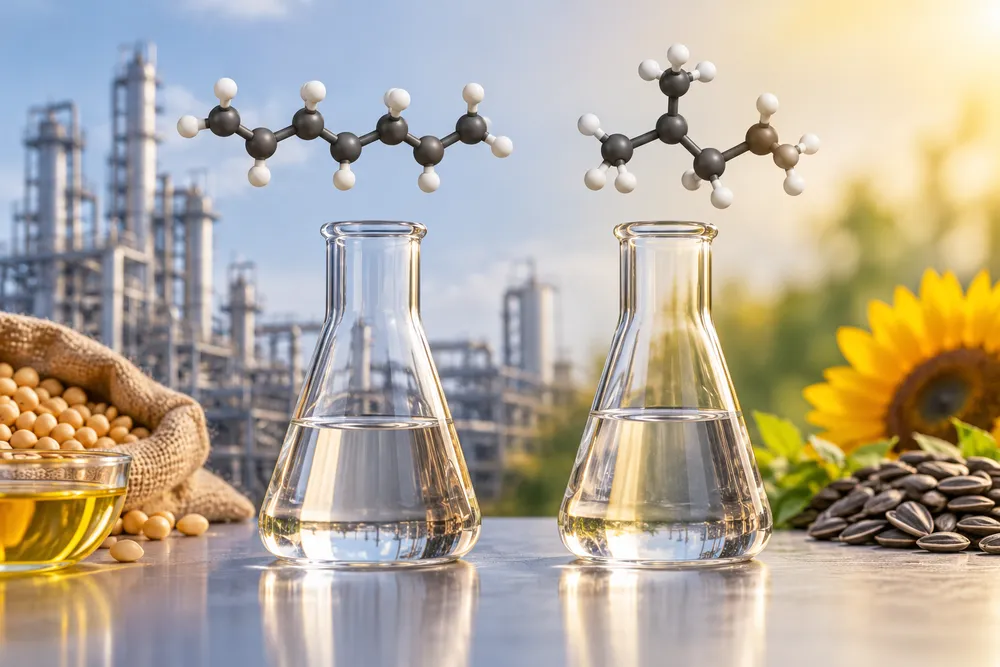
Three industrial routes supply the market. First, fat and oil splitting: natural triglycerides from tallow, palm or coconut are hydrolyzed or transesterified, yielding fatty acids or methyl esters plus crude glycerol — historically a soap-making co-product. Second, biodiesel production, today’s dominant source: transesterification of vegetable oils releases roughly 10 kg of crude glycerol per 100 kg of biodiesel, and the biodiesel boom reshaped global glycerol economics. Third, synthetic routes from propylene via allyl chemistry, now a minor share. Crude glycerol (80–88%) is refined by vacuum distillation, ion exchange and carbon treatment to 99.5%+ USP or 99%+ technical grades — the refining depth, not the route, determines final quality.
Physical and Chemical Properties
- Complete miscibility with water and alcohol; strong water-binding (hygroscopic even below 50% ambient humidity).
- High viscosity (about 950 mPa·s at 20 ℃) — the body behind its lubricant and thickener roles; drops sharply with temperature.
- High boiling point 290 ℃ and negligible vapor pressure: stays in formulations, does not flash off.
- Triol chemistry: esterifies to monoglycerides and diglycerides (emulsifiers), etherifies to polyglycerols, initiates polyether polyols.
- Low toxicity, sweet taste approximately 60% of sucrose sweetness, non-cariogenic.
Applications in Depth
Cosmetics and Personal Care
Glycerol is the reference humectant of skin care: it holds water in the stratum corneum, promotes softening of the outer skin layer, and improves spreading and after-feel of creams and lotions at typical use levels of 3–10%. It conditions hair, plasticizes soap bars (preventing cracking and sweat), stabilizes toothpaste pastes, and acts as solvent and sweetener in oral-care formulas. Formulators usually pair it with lighter humectants — for example propylene glycol — to balance tackiness.
Food Industry
In food, glycerol is a humectant that keeps cakes, candies and chewy products moist, a solvent for flavors and colors, a sweetener, a filler in low-fat products, and a carrier for extracts. Its boiling point and sweetness make it irreplaceable in confectionery moisture control; regulatory listings treat it as a food additive with broad permissions (E422 in the EU).
Pharmaceuticals
Glycerol serves as suppository base (osmotic laxative action), syrup and elixir solvent, tablet lubricant and coating plasticizer, and humectant in dermatological preparations. USP-grade material with controlled water, diethylene glycol traces and heavy metals is the entry ticket.
Polyurethanes and Resins
As a trifunctional initiator, glycerol starts polyether polyols for rigid polyurethane foam — the crosslink density it brings suits insulation and structural foams. It also plasticizes and flexibilizes alkyd resins and cellulose derivatives. Readers interested in the polyol chain will find our pentaerythritol-derived CO2 polyether polyol article a related deep-dive.
Industrial and Technical Uses
Glycerol lubricates machinery in food plants where oil contact is unacceptable, antifreezes and de-ices (its hygroscopic solutions resist freezing), plasticizes cellophane and paper, conditions tobacco (retaining moisture and flavor), suppresses dust on roads and in mining, and glycerol-water baths freeze-dry and thermostat laboratory equipment. Its esters emulsify and lubricate in textile spinning; its chemistry feeds nitration, bromination and oxidation product trees.
Animal Feed
Glycerol is an energy ingredient in ruminant and pig feed — a dense, sweet, dust-free energy source that also binds premixes and improves pellet quality. Feed-grade material requires controlled methanol residues, a carryover from biodiesel refining that reputable suppliers certify to feed limits.
Grades and Quality Standards
Crude (80–88%), technical (95–99%) and USP/E422 grades (99.5–99.7%) structure the market. The USP monograph governs identity, water (below 0.5% typical for 99.5% grade), diethylene and ethylene glycol traces (must be absent), chlorides, heavy metals and color. EastChem supplies 95% and 99.5% grades with per-batch COA covering assay, water, ash, chlorides, heavy metals and color, in 250 kg drums, 1250 kg IBC totes or flexitanks.
Handling and Storage
Glycerol is low-toxicity and non-regulated for transport — one of the easiest molecules on any chemical site. Its enemies are water pickup (hygroscopicity drifts the assay) and heat discoloration over long storage. Keep containers sealed in dry storage, use dedicated pumps, and retest water on lots stored beyond twelve months. Shelf life is 24 months and more under proper conditions.
Market Dynamics: the Biodiesel Coupling
Glycerol supply is structurally coupled to biodiesel production: every 100 tons of biodiesel yields roughly 10 tons of crude glycerol, so fuel mandates and vegetable-oil economics set the rhythm of glycerol availability and price. For buyers this coupling cuts both ways — ample co-product supply keeps prices attractive, but biodiesel cycles create waves of crude material whose refining quality varies. The practical defense is supplier-side: a refiner with distillation and ion-exchange depth turns crude waves into consistent USP-grade output, and buyers who audit that refining capability (rather than just the co-product source) enjoy stable quality through market swings. EastChem’s glycerol program is built on exactly that refining discipline, backed by 19 years of manufacturing across three subsidiaries.
Refining Technology in Brief
Crude glycerol (80–88%, carrying methanol, salts, soaps and color) upgrades through a standard but demanding sequence: methanol recovery, chemical treatment to split soaps, vacuum distillation in high-efficiency columns, and polishing by activated carbon and ion exchange. The distillation stage sets the ceiling on color and odor; ion exchange sets ionic contamination; carbon removes the last color bodies that survive distillation. Water specification is controlled by final drying. Buyers can read refining quality directly from the COA: consistently low color, chloride and heavy metals lot after lot means real refining, not lucky feedstock.
The Glycerol Derivatives Family
Glycerol is the parent of a derivative family buyers often cross-source. Mono- and diglycerides (glycerol esterified with fatty acids) are the workhorse food emulsifiers of bakery and margarine systems. Polyglycerol and glycerol esters build emulsifier and lubricant chemistry. Glycerol carbonate is an emerging specialty intermediate. Epichlorohydrin can be made from glycerol (see our epichlorohydrin product line for the other side of that market). Nitration of glycerol has a long history in energetic materials, strictly regulated. Each derivative inherits glycerol’s refining quality — one more reason the grade discipline of the parent molecule matters downstream.
Sustainability Position
Glycerol is one of the few large-volume chemicals whose main supply stream is renewable: biodiesel co-product glycerol carries the feedstock’s biogenic carbon, and its use in formulations displaces petrochemical humectants and polyols. Downstream, glycerol’s low toxicity and ready biodegradability clear environmental screening that many synthetics fail. For brands building sustainability claims, oleo-refined glycerol therefore earns its place in ingredient stories — provided the refining chain behind it is documented, which is exactly what a per-batch COA trail delivers.
Why Source Glycerol from Dongying EastChem
We are a 19-year chemical manufacturer with three subsidiaries and stable, fresh glycerol stock — the response to a market where biodiesel cycles swing availability. Quality is only the foundation; dependable logistics and same-day technical answers decide whether a supplier is reliable over years. Consolidation completes the offer: glycerol ships with propylene glycol, ethylene glycol and the wider oxygenates range in one container, one document set. MOQ one 20-foot container, samples in about 2 days, payment by T/T or L/C.
About this guide: this overview covers glycerol properties, production, grades and applications as used by our industrial, food-chain and personal-care customers. Typical values are indicative; the delivered COA governs. Grade descriptions, market context and application guidance reflect our current supply program and are revised as regulatory and market conditions move. Food-chain, personal-care and industrial buyers can request the complete documentation pack, retention-sample arrangements and the consolidation map showing how glycerol ships alongside glycols and other oxygenates in mixed containers. For buyers new to the category, the practical starting questions are simple: which grade fits the end use, which documentation the destination market expects, and what container mix minimizes landed cost — and our desk answers all three with a single quotation, sample arrangement and document set. Contact information for the responsible sales engineer appears at the end of this page.
Frequently Asked Questions
What is the difference between glycerol and glycerin?
They are the same compound, propane-1,2,3-triol. “Glycerin” is the trade and USP name; “glycerol” is the formal chemical name.
Which grades do you supply?
Technical 95% and 99.5% (USP-type) grades, each with a batch-specific COA covering assay, water, chlorides, heavy metals and color.
Is glycerol safe for food and cosmetics?
USP/E422-grade glycerol is a broadly permitted food additive and cosmetic ingredient. Technical grade is for industrial uses only.
Why is glycerol hygroscopic and why does it matter?
Its three hydroxyl groups bind water strongly. That is the working principle behind its humectant uses — and the reason storage must stay sealed: open drums gain water and drift below assay.
Can glycerol be used in polyurethane foams?
Yes — as a trifunctional initiator for rigid-foam polyether polyols, where it builds the crosslink density insulation foams need.
What packaging do you offer?
250 kg drums, 1250 kg IBC totes, or flexitanks for bulk shipment, with consolidation alongside our glycols and other oxygenates.
Contact for quotations and samples:
Billy Lu
WeChat/Phone: +86 182 5464 4858 · WhatsApp: +86 182 5464 4858
Email: [email protected] · Alibaba: dyeastchem.en.alibaba.com